Saturday, July 30, 2011

Preserving and Sharing Family Recipes PDF from Family Tree Magazine

I thought I would pass along an offer I received in my email today.  Family Tree Magazine has a sale going on for some research guides that cover all kinds of genealogical research.  One of the PDFs  by Karen Edwards is the Step-by-Step Guide: Preserving and Sharing Family Recipes. You can order it for  $4.00 and it's downloaded to your computer. 

While I haven't talked about recipe cards on this blog, obviously they are an important family heirloom. Consider taking some time to preserve them and share them with others so that your family food traditions can be passed down.

There is also one other cooking related PDF on this flyer, which is History Matters: Utensils.


**Disclosure: I am writing a book for F + W Media which publishes Family Tree Magazine.  I have purchased many F + W Media products over the years.  No one asked me to post this article.

Friday, July 29, 2011

Food Friday: You Say Stuffing, I Say Dressing

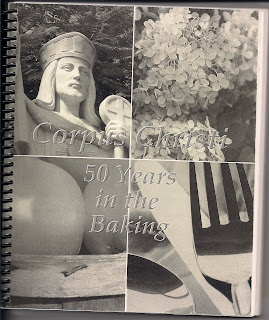
Today's Food Friday is unseasonal but it shows an aspect of community cookbooks that can be important to genealogists.  Some cookbook, allow contributors to write a line or two about the origin of the recipe they are submitting. Such is the case with today's post from the Corpus Christi: 50 Years in the Baking church cookbook.

Unfortunately, I can't tell you too much about this cookbook. There is no publish date, though my guess is it's within the last 10-20 years.  They mention Pacific Palisades in the introduction, so it appears to be from a parish in Pacific Palisades, California. This volume has lots of images, and places where contributors have talked about the recipe and where the recipe has been served, influences, etc.

Which brings us to today's recipe for Grandma Hannah's Thanksgiving Dressing by Carolyn Highberger whose recipe came via her mom who stood by her grandmother to record the recipe.


Not all community cookbooks follow the formula of only having a name with a recipe. While even that little information provides us with rich information, there are community cookbooks that include much more.

Friday, July 22, 2011

Food Friday: Perfection Salad

Couldn't everyone use a little Perfection Salad?  One recipe for it, shown below, comes from the Klamath Falls Ward (LDS Church), Klamath Falls, Oregon from their cookbook Our Favorite Recipes (1959).


Community cookbooks often have other types of advice or recipes aside from things to cook.  Mock recipes like "How to Cook a Husband" offered advice in a lighthearted way.  Cookbooks also featured household tips and healing advice.  The front pages of Our Favorite Recipes provides some household tips that provide ideas to make life easier, not just how to clean your house.


Friday, July 15, 2011

Food Friday: Woman's Relief Corps of the Grand Army of the Republic

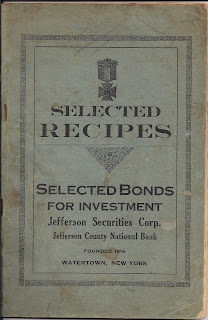
Sometimes, especially with female ancestors, we forget that  they may have been involved in a membership organization. Many different kinds of women's auxiliaries, organizations and clubs existed.  One example is found in this community cookbook, simply titled Selected Recipes.


This book published by  the Joe Spratt Woman's Relief Corps (Watertown, New York)  is filled with recipes, none of  which are attributed to anyone. (The Woman's Relief Corps was an auxiliary to the Grand Army of the Republic.)  However, the real value is in the advertisements. Most likely this booklet has more ads than recipes but it gives us a great way to reconstruct the community.  This cookbook and its ads almost seem like a city directory.


This cookbook appears to be from the early 20th century, there is no date, and while it contains no names of the members of this branch of the Woman's Relief Corps it does tell us much about their community. One of the interesting aspects of the ads is that they include a page with the names of different men running for public office.  A great idea on those politician's parts taking advertisements out in a cookbook.  My guess is this cookbook might have been published around 1920, when women were granted the right to vote. Additional research will help me pinpoint an approximate date.


If you Google "Joe Spratt Woman's Relief Corps" you will find additional information about this group through sources like Google books and newspapers found on the website Old Fulton Post Cards .

The recipe I chose for this Food Friday is one that illustrates one of the important aspects of researching cookbooks.  Women wrote in their cookbooks.  They made comments, made changes to the recipe, gave information about the contributor and wrote their experiences with the recipe. Some women stored newspaper clippings, other recipes and even letters in their cookbooks. Unfortunately, this cookbook owner didn't put her name on the book, but we can see what she thought of this doughnut recipe.

My guess is this recipe might not be very good.  Try it at your own risk.

Friday, July 8, 2011

Food Friday: Roast Rabbit or Squirrel

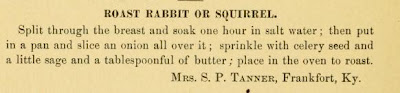
This Food Friday comes from the cookbook, Pittsburgh Tested Recipes, Prepared by the Ladies of Trinity ME Church (Smallman and Twenty-Fifth Streets). 1885.

One of the recipes in this collection is for Roast Rabbit or Squirrel (p. 152). The first thing you might  notice about this recipe is the lack of directions and measurements. While there is a mention of a tablespoon of butter, the rest of the measurements are lacking. We also aren't told how long to cook the dish for. Cookbooks during this time period assumed that you knew "basics" of cooking  so the recipes did not provide this information.  Later, cooking instructor/cookbook author Fannie Farmer among others start adding measurements and exact directions in recipes, allowing women to follow a recipe and end up with the type of dish that the recipe gave instructions for.


This lack of instruction is very obvious in the next recipe found on the same page for Cookies.


The recipe for rabbit/squirrel is also a good reminder that our ancestor ate what was available to them. In an age where eating organic, local food wasn't a fad but a part of life, eating things that were native to your area and that provided an easy food source was a necessity.

Cluster Genealogy Points to Other Localities

The other thing to notice about the rabbit/squirrel recipe is that it is provided by a woman in Kentucky. This  recipe found in a Pennsylvania cookbook most likely indicates that the contributor had lived in the Pittsburgh area at one time or had some sort of connection to a person in this church (maybe she was a sister-in-law or is a sister to one of the women). A good reminder that sometimes our ancestors are listed in places other than the locality where they lived.

An example of being listed in a resource in another locality that we as genealogists are more familiar with is obituaries.  An obituary may be placed in the newspaper where the person lived and also in other newspapers around the country where a close relative lives or where the deceased lived at some point in their life.

Community Cookbooks are the City Directories of Women

Community cookbooks are much like city directories. They are a listing of a community of women, sometimes from a church, civic organization, membership group or a town. But aside from just the women, businesses are also listed, giving you a snapshot of that town during that time period.  Those listings can be helpful in finding other documents in manuscript collections relating to your ancestor.  Knowing the name of the local doctor, midwife, and funeral home can lead you to records that those people left behind that may mention your ancestor and their family.